

We keep asking whether to slow down or speed up. That’s probably the wrong question.
There is a conversation happening everywhere right now about discernment. Much of it centers on AI itself: as machines take on more of the work of effort, what becomes of human judgment? What does it mean to exercise genuine discernment in a world where the raw cognitive labor of analysis, synthesis and decision-making can increasingly be offloaded?
As this topic swirls around, I am regularly thinking about where and how it applies to strategic change. One of the places where discernment is urgently needed right now has many strategic and practical implications: how do organizations manage change itself?
Because the failure I see most often in transformation work is not a failure of effort. It is a failure of judgment about which changes are worth the effort in the first place, and in what order.
The situation most leaders recognize
Many organizations – mine included – are navigating something genuinely unprecedented: AI transformation, structural reorganization and new strategic growth models, simultaneously and at pace. The people doing this work are talented, committed and increasingly exhausted. The concept of “change readiness” has often been completely abandoned.
The easy conclusion is that we are doing too much, too fast, and the answer is restraint. Maybe we should just slow down, protect capacity and pause the lower-priority work. Meh.
There is truth in that. But I think it misses something more important.
Not all change is equal, and that distinction matters more than speed
Some change builds capacity. It leaves teams more capable, more confident and better positioned for what comes next. The learning curve may be steep, but people emerge from it with something real and durable.
Some change consumes capacity. It absorbs time, attention and cognitive energy without leaving much behind. It generates activity and progress metrics without producing the underlying capability it promised.
The problem is that in the fog of transformation, these two types of change look nearly identical from the outside (sometimes from the inside, too). Both have sponsors. Both have timelines. Both produce fatigue.
But they are not the same. Treating them as equivalent, whether by accelerating both or restraining both, is where we go wrong.
The real capability isn’t restraint. It’s discernment: the ability to tell the difference between change that builds capacity and change that consumes it, and to sequence accordingly.
What this distinction looks like in practice
For leaders and managers navigating AI transformation alongside strategic reorganization, here are some scenarios (i.e. guiding principles of a sort) worth stress-testing against your own reality:
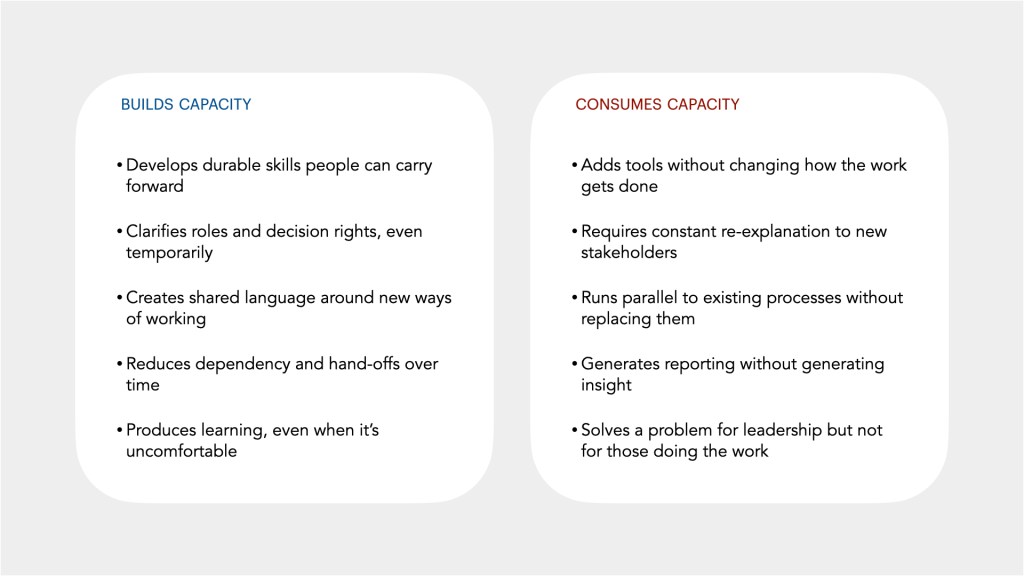
This is not a perfect taxonomy. Real initiatives rarely fall cleanly into one column. But the exercise of asking which column a given change lives in is clarifying in ways that “high priority vs. low priority” often is not.
This is also where the broader conversation about discernment and AI connects directly to change leadership. As AI tools take on more of the analytical and synthesizing work in our organizations, the distinctly human contribution becomes the quality of judgment we bring to questions like these. Not just what to do, but what to do first, what to stop and why. That is a discernment problem, not an effort problem.
Why this requires change leadership at the table earlier
Discernment of this kind cannot happen in implementation. By the time a change initiative reaches the execution stage, the sequencing decisions have already been made. At this point, the sponsors are committed, timelines are set and the organizational energy has already been pledged.
[T]he organizations that navigate this well …will be the ones that learned to tell the difference between change that depletes and change that compounds, and that gave their people the conditions to exercise that judgment.
If change leaders — the people who understand capacity, readiness and the human cost of concurrent transformation — are only brought in to manage the aftermath of strategic decisions, we are structurally prevented from doing the most valuable work available to us.
The question of whether a change builds or consumes capacity has to be asked before the initiative is scoped, not after people are already depleted by it. That requires genuine involvement during strategy formation, not just delivery.
Three questions worth sitting with
If you are leading a team right now, or leading leaders, here are a few things worth considering:
First: if you mapped every active change initiative touching your team right now, how many of them leave people more capable at the end? How many primarily ask people to absorb, adapt and endure?
Second: are you sequencing changes so that capacity-building work lands before or alongside the hardest capacity-consuming work, or are they arriving at the same time, competing for the same people?
Third: do the people closest to the work have a meaningful way to tell you when a change is consuming more than it is building? Not through a survey six months later, but in real time, in a way that can actually change a decision?
Most organizations do not have good answers to any of these. That is not a failure of effort or intent. It is a structural gap that the current moment is making very…expensive.
We are going to keep transforming. The pace is not returning to something more comfortable. But the organizations that navigate this well won’t be the ones that went fastest, or the ones that slowed down most thoughtfully. They will be the ones that learned to tell the difference between change that depletes and change that compounds, and that gave their people the conditions to exercise that judgment.
That is the capability worth building right now.
The conversation about discernment in the age of AI is one I find myself in constantly, and it keeps showing up in unexpected places. This is one of them. What does this look like in your context? If you are managing a team through simultaneous AI transformation and strategic change, what tells you a given initiative is building capacity versus consuming it?


Leave a Reply