

Saying the profession needs to change is the easy part. What it actually looks like to do this work differently is considerably harder to answer.
In my last piece, I argued that AI is forcing a structural rethink of change management from a project-based discipline with a beginning, middle and end, to something more like a continuously sensing, adapting organism (I do still like the idea of an octopus!). The response suggested that argument landed for a lot of people. What the comments and messages also made clear is that the next question is the harder one.
Okay. If change management isn’t a project anymore, then what is it? And what does that actually mean for how we show up every day?
I’ve been sitting with that question. This is my attempt at an honest answer.
The identity shift underneath the job description shift
Let’s start with what I think is the deepest change, because I don’t see it discussed enough: this transition is not primarily about new tools or new frameworks. It’s about professional identity.
Most of us came into this profession oriented around delivery. We are, at our core, people who are good at getting things done — at mobilizing, sequencing, communicating, training, and closing out. That orientation has served us and our organizations well. It is also the thing we may need to loosen our grip on.
An organism doesn’t get delivered. It gets cultivated. The shift from deliverer to cultivator is the identity transition underneath all the practical ones. And identity transitions are uncomfortable in ways that skill development simply isn’t. You can learn a new tool in a weekend. Letting go of a professional self-concept takes considerably longer.
“The practitioners who will thrive in this next chapter are not those who learn AI fastest. They are those who are honest enough with themselves to examine what they’ve built their professional worth around — and flexible enough to rebuild it.”
How the job may look and work differently
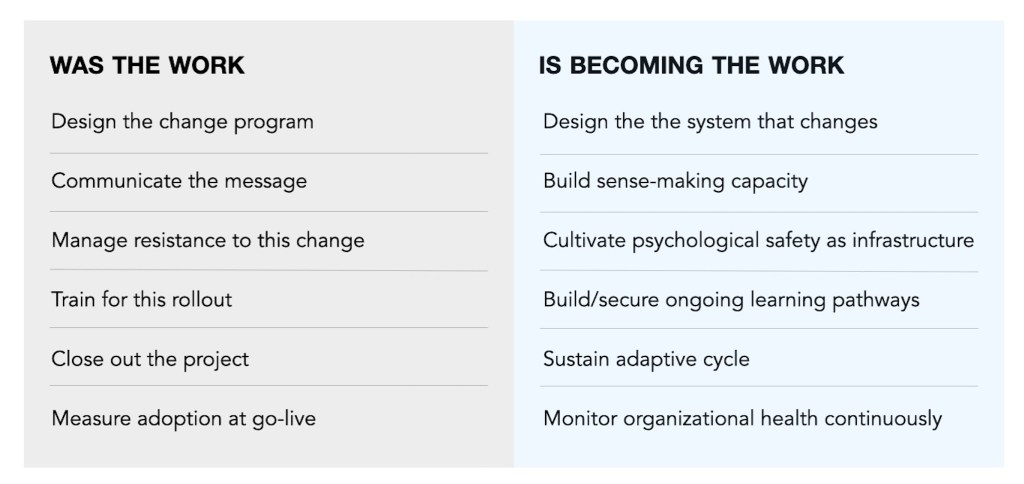
Concretely, I think the work shifts across four dimensions. None of these are entirely new and the best change practitioners have always done versions of them. What changes is the proportion of time, the expectation of permanence and where in the organization’s decision-making these activities now need to sit.
- From program design to system design. The question we used to ask was: what does this change program need to look like? The question we now need to be asking is: what does this organization need to look like in order to be continuously capable of changing? That means helping to design the feedback loops, the governance structures, the norms and rituals and the leadership behaviors that make adaptive capacity a structural property of the organization (versus a feature of a well-run project).
- From communication planning to “sense-making” infrastructure. We have always been communicators. What AI changes is both the richness of data available about how people are actually experiencing change and the speed at which the change itself is evolving. Our job is less about crafting the message and more about building the organization’s capacity to make meaning in real time. How can we help people navigate ongoing exposure to novelty?
- From managing resistance to building psychological safety as a structural condition. Resistance management has always felt slightly adversarial to me because it positions the change practitioner as someone who smooths over objections so the organization can move forward. The more accurate and more useful framing is this: people resist change that feels unsafe, unclear or imposed. Our job is to create the structural conditions (i.e. honesty, inclusion, genuine dialogue and visible leadership accountability) that make change feel less threatening. That’s not a project activity. It’s an organizational design activity.
- From delivery accountability to organizational health stewardship. This is perhaps the most significant shift in practical terms. We have historically been accountable for the success of specific initiatives. In a continuous change model, that accountability needs to expand to something like organizational health, or the ongoing capacity of the human system to absorb, adapt and regenerate. That’s a harder thing to own. It’s also the more important thing.
Why this is genuinely hard — and not just in the obvious ways
I want to be honest about the difficulty here, because I think we do each other a disservice when we talk about professional evolution as if it’s simply a matter of deciding to grow.
The structural challenge is that most organizations are not yet buying what I’ve just described. They are still hiring change managers to run projects. They are still measuring us on initiative-level outcomes. They are still bringing us in after strategic decisions are made and asking us to manage adoption of a plan we had no hand in shaping. The gap between what the work needs to become and what organizations are currently willing to fund and authorize is real, and it falls to practitioners to bridge it, often without explicit permission.
There is also a genuine risk I raised in my last piece that I want to return to: deskilling. If we allow AI to scaffold too much of our diagnostic and analytical work without developing the underlying judgment to know when the model is wrong, we become brittle. The value of a skilled change practitioner has always resided in their ability to read a room, hold a difficult conversation and navigate the political landscape of a resistant leadership team. None of that is captured in a readiness dashboard. If we mistake the dashboard for the diagnosis, we are in trouble.
“AI will tell you where resistance is forming. It will not tell you what the resistant person actually needs to hear, or who in the room has the relationship to say it.”
And then there is the personal challenge that I think is most underacknowledged: continuous change work, done well, is exhausting. Projects have endings. They have moments of completion and celebration and the satisfaction of having delivered something. An organism never finishes. If we don’t build in recovery, reflection, and renewal — for ourselves and for our organizations — we will burn out doing work that never closes.
What success looks like when there is no finish line
This may be the question I find most genuinely interesting and most unresolved.
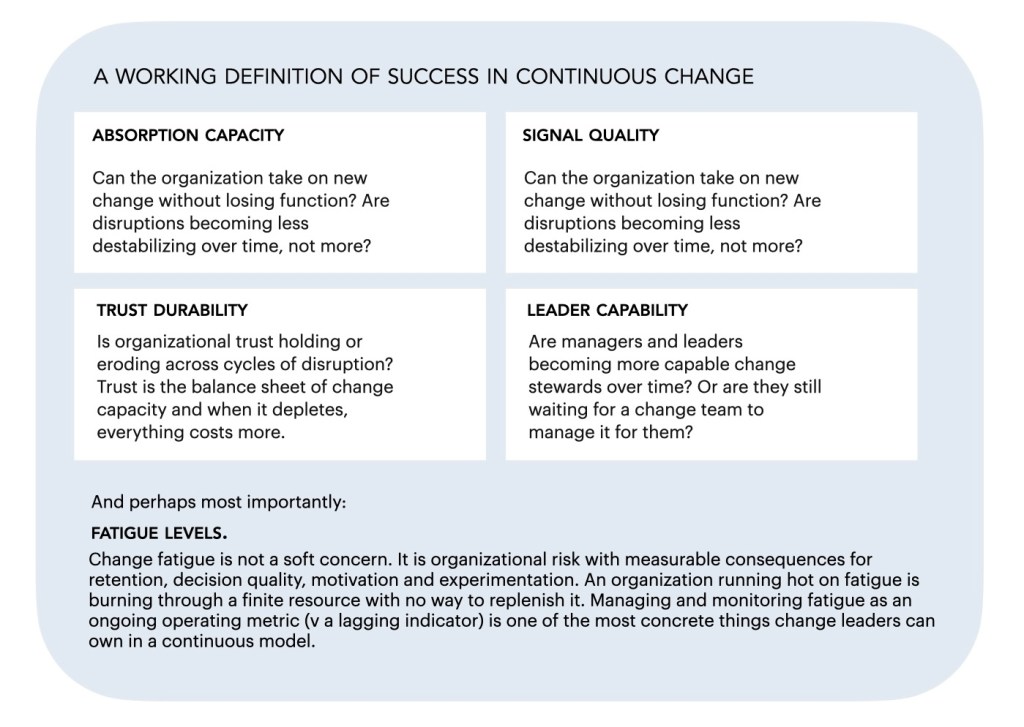
Project-based change management offers a clear definition of success: did we deliver on time, on budget, with acceptable adoption rates? Those metrics were imperfect, often lagging and frequently gamed. But at least they existed. A continuous change model needs a different success vocabulary, and I don’t think the profession has fully developed it yet.
Here is my working attempt at markers of success that I think apply in a permanent change environment:
The case for why this is also genuinely exciting
I’ve spent most of this piece in the difficulty. Let me end somewhere else.
For as long as I’ve been in this profession, change management has had to argue for its seat at the table. We have made the business case, cited the statistics on initiative failure rates, and appealed to executives who remained politely unconvinced that the human dimension of transformation was actually their problem.
AI has changed that argument permanently. Not because executives have suddenly become more people-centered (though some have), but because the stakes of getting the human side wrong are now visibly higher and arrive faster. An organization that deploys AI at speed without the change capacity to absorb it doesn’t fail slowly and quietly. It generates resistance, attrition, shadow adoption, and governance failures that become visible at the board level.
That means the conversation we have always needed to have about trust, capacity, the pace of human change versus the pace of technological change is now one that organizations actually need to have. We are being asked to solve the problem of what happens when the speed of the machine exceeds the speed of the human.
That is a genuinely important problem. It is also, I think, the most interesting version of this work I have encountered in my career.
I’m continuing to develop thinking on what organizational change capacity looks like in practice — the metrics, the design principles, the leadership behaviors that actually build it. If these questions are relevant for you in your organization, I’d welcome the conversation.
 Emily Mercier | Transformational Change Strategist
Leave a comment